A chocolate tin is one of those packaging decisions that looks simple from the outside and isn't. The chocolate inside is fragile, fat-rich and temperature-sensitive. The tin has to protect it through a 30-day sea freight, survive a pallet stack, look premium under retail lighting, and still be nice enough that the customer keeps the box after the last praline is gone.
Most failed chocolate tin projects fail for the same three reasons: the capacity was guessed instead of calculated, the insert was treated as an afterthought, and the order was placed too late for the holiday it was meant to catch. This guide is built to prevent exactly those three. It walks through the decisions in the order a factory actually needs them — chocolate format first, then capacity, then structure, then finish — and every recommendation is anchored to a real production case you can open and inspect.
If you want to see the range of what's already been produced before reading further, browse the chocolate tin case library — 19 real production runs with capacities, coatings and mould references listed on every case page.
What a chocolate tin actually has to do
Before comparing shapes and prices, it helps to be explicit about the four jobs the tin is doing at once. When a project goes wrong, it's almost always because one of these four was quietly sacrificed for another.
| Packaging option | What it does best | Best suited for | Relative cost | Watch out for |
|---|---|---|---|---|
| Tinplate chocolate tin | Barrier against light, moisture and odour; crush resistance; reusable | Premium assortments, gifting, seasonal SKUs, long sea freight | Medium–high | Conducts heat; needs an insert for loose pieces |
| Paperboard chocolate box | Low cost, easy die-cut shapes | Local delivery, short shelf life, very high volumes | Low | Crushes in transit, weak moisture barrier |
| Flexible pouch | Lowest weight, resealable | Everyday snacking formats | Low | No shape retention, poor gift perception |
| Rigid plastic box | Clear display, cheap tooling | Budget retail, party packs | Low–medium | Weak sustainability story, scratches |
The tin's advantage is the combination: it is the only option in that table that blocks light completely, resists crushing, prints in full colour with metallic finishes, and stays in the customer's kitchen for years afterwards. That last point matters more than most brands realise — a well-made chocolate gift tin keeps advertising your brand long after the contents are eaten. We compare the materials in depth in metal tin vs cardboard box vs pouch.

Start with the chocolate, not the tin
The single most useful habit in chocolate packaging: describe the chocolate before you describe the box. Every downstream decision — capacity, insert, lid, even the finish — changes once you know what form the chocolate takes. If you're not sure where your product sits, the diagram below is the 30-second version.

Pralines and truffles: the insert decides everything
Soft-centred pieces deform under their own weight, pick up scratches, and shed cocoa butter dust onto their neighbours. They need individual cavities — either a food-safe PET tray or moulded paper cups — with just enough clearance to allow for a foil wrapper. Square tins in the 700–1100 ml range are the workhorse format here because a standard tray grid fits them efficiently. A good example is the Moonlight Chocolate Tin, an 889 ml square with a matte finish and a base coat, or the Luxury Chocolate Gift Tin at 1054 ml for larger assortments.
Bars and slabs: flat, rigid, low profile
Chocolate bars don't need cavities — they need a flat, low rectangular tin that holds them straight and doesn't let them rattle. The Dark Chocolate Coffee Tin Can is a compact 148 ml format sized for single-bar or tasting portions; for multi-bar sets, a slim slip-lid tin in the 150–300 ml range does the job with less material cost.
Cocoa powder and drinking chocolate: moisture is the enemy
Powder products don't break — they clump, absorb odours and go stale. Here the priority flips from structure to seal quality: an airtight round tin, ideally with an inner lid, in the 500 ml-plus range. The round Cocoa Chocolate Tin (1077 ml, matte finish) shows the format; a smaller 165 ml round cocoa tin works for single-origin retail portions.

Seasonal and gift editions: the tin *is* the product
For Valentine's, Easter and Christmas SKUs, the packaging carries most of the purchase decision. This is where shaped tooling earns its keep: heart-shaped tins for February, egg-shaped minis for Easter, tree shapes and handle carriers for December. The heart-shaped chocolate tin at 255 ml and the Pink Rabbit Easter Egg Chocolate Gift Tin at under 20 ml show how far special-shaped tooling can go.
Chocolate tin sizes: how to translate pieces into capacity
The most common quotation mistake in this category is describing the tin by "grams of chocolate". A tin's mould capacity is measured in millilitres, and the number of chocolates it holds depends on their footprint, wrapping and the insert layout. A practical rule of thumb for foil-wrapped or paper-cup pieces: each chocolate occupies roughly 40–60 ml of tin volume, then leave about 10% headroom for the insert and cushioning.
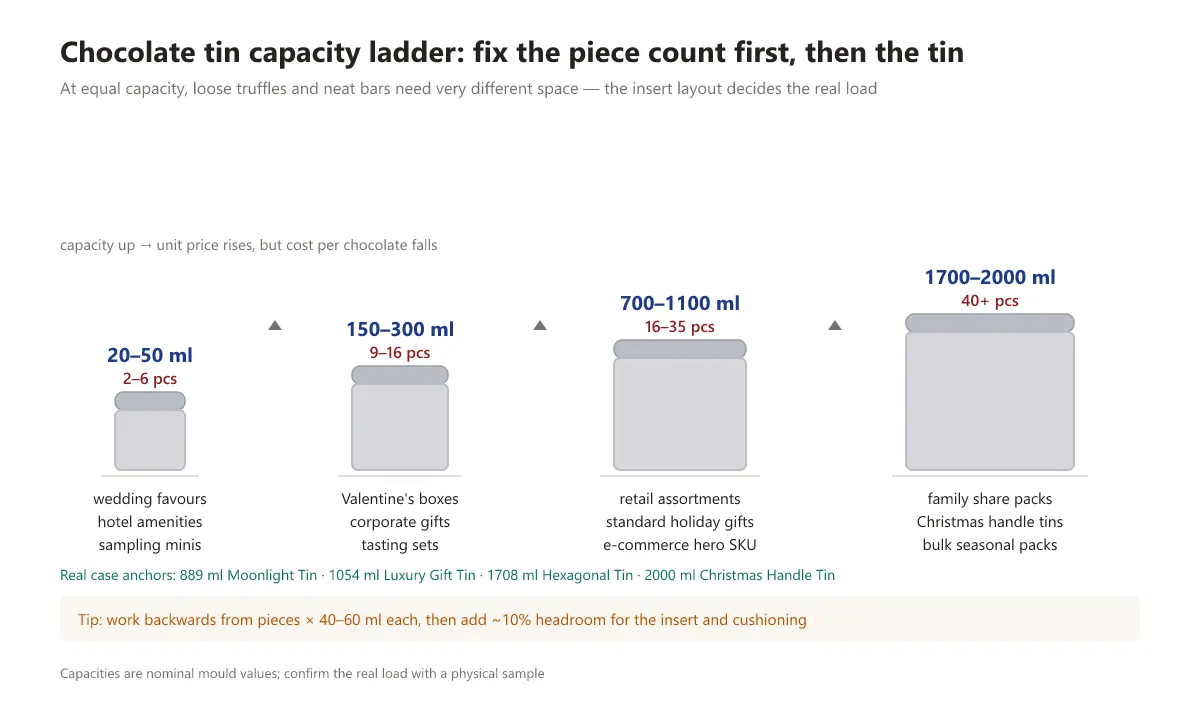
| Tin capacity | Typical fill | Common use | Real production example |
|---|---|---|---|
| 20–50 ml | 2–6 mini pieces | Wedding favours, hotel amenities, sampling | Truffle tin, 42 ml · Easter egg tin, 19.8 ml |
| 150–300 ml | 9–16 pieces | Valentine's, corporate gifts, tasting sets | Heart-shaped tin, 255 ml · Bar tin, 148 ml |
| 440–500 ml | 12–20 larger pieces | Window-display retail, biscuits-plus-chocolate mixes |

Two details worth checking before you commit to a size:
- Stacking height. Retailers plan shelf space in facings; a tin that's 5 mm taller than the planogram can lose the listing. Confirm the filled height, not just the mould drawing.
- Empty-tin nesting. Tins ship nested to save freight. Ask how many stack per carton — it directly changes your landed cost per tin. The mould library at cntinworld.com/models lists over 4,000 ready moulds, and the chocolate tin section alone has 329 ready-made chocolate box moulds, so it's usually possible to test capacity against an existing mould before committing to new tooling.
Food safety: what to demand from a chocolate tin manufacturer
Chocolate is one of the more demanding foods to package: it's fatty, it absorbs odours, and it sits in the tin for months. Any chocolate tin manufacturer you shortlist should be able to state, in writing:
- Food-grade tinplate as the base material, with a protective inner lacquer suitable for fat-rich contact.
- Coating systems compliant with your destination market's rules — FDA for the US, LFGB for Germany and much of Europe, with BPA-NI (non-intent) coatings available if your brand standard requires it.
- Odour-neutral printing: offset inks are applied to the outside of the tin and a protective varnish separates ink from product; a factory that can't explain its ink and coating system is a red flag.
We explain the coatings and test standards in detail in are tin cans food safe? FDA, LFGB and food-grade coatings explained. For cocoa powder and drinking chocolate, ask specifically about moisture performance — a plain slip lid is fine for solid chocolate but marginal for powder, where you want an airtight structure instead.
Inserts: the part buyers skip and pralines pay for
If there's one section of this guide to read twice, it's this one. The tin protects against crushing and light; the insert protects each piece from every other piece. These are different problems, and the second one causes most of the damage claims.
| Symptom after shipping | Likely cause | What to specify next time |
|---|---|---|
| Pieces stuck together, surfaces shiny | Wrappers melted against each other — no separation | Individual paper cups or a PET tray with one cavity per piece |
| White streaks on chocolate surfaces | Temperature fluctuation in transit (sugar/fat bloom), not the tin itself | Insulated outer carton + avoid summer dwell; the tin can't fix a logistics problem |
| Scratched printed foil on tops | Pieces free to slide inside the tin | Snug-fit insert; cavity depth matched to piece height |
| Tin arrives dented at corners | Inner carton under-specified for pallet stacking | Corrugated spec review + drop test before mass production |
| Tin smells of ink on opening | Printing varnish under-specified | Food-grade inner lacquer line item in the quotation |
Insert materials, in rough order of cost: moulded paper cups (recyclable, best for uniformly sized pieces), PET plastic trays (precision cavities, best for premium assortments), EVA or flocked foam (luxury feel, higher unit cost and a weaker recycling story). Whatever you choose, the insert should be quoted as part of the tin — retrofitting one later is how sizes drift.

Lid structures and when each one wins
The lid is where user experience and shelf display meet. The full taxonomy lives in tin can lid types explained, but for chocolate specifically:
- Slip lid — cheapest, cleanest look; fine for bars and solid pieces, marginal for powders.
- Hinged lid — premium feel and easy reopening; ideal for office-desk gifting where the tin gets reused. The hinged lid mould category has 80 ready moulds.
- Window lid — lets retail customers see the actual chocolates; the strongest conversion lever on shelf. 251 window-lid moulds exist in the window tin category; the Christmas square window tin shows the effect.
- Airtight / screw structure — the choice for cocoa powder and drinking chocolate; see the airtight category.

Finishes: what makes a chocolate tin look expensive
Premium perception in metal packaging is mostly two things: surface finish and dimensional detail.
- Matte vs gloss varnish. Gloss saturates photographic artwork and makes colours pop; matte reads calmer and more expensive on dark colour schemes. Both are standard options on the same tin — you choose per panel.
- Hot-foil gold and metallic inks. Metallic Pantone inks and gold foil accents lift dark green, deep red and black bodies — the classic Christmas chocolate tin look. The Gilded Craft Chocolate Tin, a round 827 ml body, is a good reference.
- Embossing and debossing. A raised logo or pattern adds a tactile cue that photography can't fake; it works best on larger flat panels. The Vintage Chocolate Gift Tin and the Kids Cocoa Tin both use embossing on matte bodies.

The processes and their cost impact are broken down in custom metal can printing explained, and if you want to preview finishes before cutting any metal, the site's AI mockup tool renders artwork onto a 3D tin in minutes.

Does a metal tin make chocolate melt faster?
This objection comes up in almost every sourcing conversation, so it deserves a straight answer. Metal conducts heat — that's true and unavoidable. But melting is a logistics problem, not a packaging problem. Chocolate softens when it sits above roughly the mid-20s °C for long enough, and it blooms (develops white streaks) when temperatures fluctuate. What ruins chocolate in transit is a hot truck, a weekend in an un-airconditioned warehouse, or a doorstep in the sun — none of which the tin caused, and none of which a paper box would have survived better.
What a tin genuinely contributes:
- Complete light barrier. Light oxidises cocoa butter and bleaches surface fats; the two packaging options that protect against it are foil and metal.
- A stable micro-climate. Once closed, the air inside a tin barely exchanges with the room, which slows odour pickup and moisture swings.
- Structure under stacking. A crushed box exposes chocolate to heat pockets and physical damage; a tin shrugs off pallet loads.
The correct summer protocol is therefore packaging and logistics together: ship in insulated outer cartons, avoid Thursday-to-Sunday dispatch windows, and use expedited service above roughly 25 °C ambient. The tin's job is to keep light, odour and crushing away from the chocolate; keeping the vehicle cool is nobody's packaging spec.
The holiday and occasion calendar: what sells when
Seasonal chocolate is a deadline business, and the real deadline is not the festival — it is the shipping date. Working backwards from an on-shelf date, a custom chocolate tin needs roughly 1–2 weeks for artwork and dieline, 1–2 weeks for sampling, 25–35 days for mass production and 30–40 days of sea freight to most Western markets. That puts the purchase order about three to four months ahead of the festival, not three to four weeks.
| Occasion | On-shelf window | Place the order | Format that fits |
|---|---|---|---|
| Valentine's Day (Feb 14) | mid-Jan to Feb 10 | Oct–Nov | Heart and round tins, 150–830 ml, red or blush body, foil or emboss |
| Easter (Mar–Apr) | 3–4 weeks before | Nov–Dec | Egg-shaped minis, pastel illustrated round tins |
| Mother's Day (May) | late Apr to May | Feb | Floral round tins 300–900 ml, matte or soft-touch finish |
| Halloween (Oct 31) | from late Sep | Jun–Jul | Bold matte 300–900 ml candy-and-chocolate tins, small cavities |
The table is the calendar. The sections below are the specification notes behind each line — because the tin that sells at Christmas is rarely the tin that sells in February.
Valentine's Day chocolate tins
February is a shape-led festival. Heart-shaped tins outsell every other format because the shape is the message, and no amount of printed flowers on a square body carries the same weight at the till. The practical range is 150–830 ml: a 255 ml heart takes roughly 4–6 large pralines or 9–12 smaller pieces, while a larger round tin in rose artwork suits a full assortment rather than a token gift.
Two details buyers routinely get wrong here. The first is the insert — heart cavities are shallow, so measure the deepest piece before approving artwork. The second is the inside lid, which is the cheapest place to put a name, a date or a short message; in February that single print turns generic packaging into a gift. Both the 255 ml cute-bear heart tin and the 827 ml pink rose love tin are production examples of each route.


Easter chocolate tins
Spring is the second-largest shaped-tin season and the most extreme in size: the category runs from miniature egg tins of around 20 ml, sold in multipacks or hung on clip strips, up to 1100 ml illustrated round tins for family sharing. Pastels, novelty shapes and playful illustration define the look, and pieces are usually small — mini eggs, pralines, hollow figures — which means many shallow cavities rather than a few deep ones.
Easter is also the festival that best rewards mould reuse: what changes each year is the artwork, not the structure. A 19.8 ml egg-shaped gift tin and an 1108 ml illustrated spring tin both start from ready-made tooling. Watch the unit economics on minis — at that size the insert and the filling labour can cost more than the tin itself.

Mother's Day, Father's Day and teacher appreciation
These occasions are gift-led rather than sweet-led, which changes the brief: the chocolate is the gesture, and the tin is expected to survive as an object. Floral or understated artwork, a matte or soft-touch finish and a 300–900 ml body cover most programmes, with an insert sized for a truffle assortment, a chocolate-and-tea hybrid or a chocolate-and-coffee pairing.
Because there is no strong shape convention in May the way there is in February, differentiation comes from finish quality and from the after-use story: a biscuit or storage tin that a customer keeps on the desk extends brand exposure all year. A 514 ml square tin with a white-coated interior is a realistic spring body — matte artwork, food-safe interior, sized for an assortment rather than a single piece. For business gifting to employees and clients, the corporate gift tin guide covers structured programmes.

Halloween and autumn party tins
Halloween is the highest-volume, most price-driven season of the chocolate year. Design language is bold and graphic — orange, black, purple — finishes are usually matte, and the fill is mixed: wrapped candies, mini bars, pralines and novelty pieces sharing one 300–900 ml tin. Cavities should be small and uniform enough to take wrapped pieces of slightly different sizes, or the tin should use a simple paper cup layout instead of a precision tray.
Cost discipline matters more here than premium finishing: keep the print structure simple, reuse an existing mould, and put the budget into artwork that reads from two metres away on a supermarket shelf. A 826 ml matte Halloween candy tin is a realistic reference point for the format, and the candy tin case library holds the wider range of mixed-confectionery bodies.

Christmas chocolate tins
Christmas is the largest window of the year and the one with the most structural variety. Window lids let the chocolate sell itself without being opened; tree and novelty shapes work as keepsake gifts; 1700–2000 ml handle carriers turn a family-size fill into something that can be carried and displayed upright; and advent or countdown formats sell the whole season rather than a single day.
A realistic Christmas line-up mixes all four: a 2000 ml copy with a carry handle for sharing, a 445 ml window-lid tin for premium retail, an illustrated 827 ml deer tin for gifting, and a tree-shaped novelty tin for the impulse shelf. Christmas orders are placed in July or August; a late PO cannot be rescued except by air freight, which usually costs more than the tins.


Chinese New Year, Mid-Autumn and lunar gifting
Lunar gifting runs on a different visual grammar: red and gold, round or octagonal bodies, embossed auspicious motifs, gold foil and metallic exposure, and capacities of roughly 400–1100 ml that suit a shared assortment or a corporate box. Much of this volume is B2B — employee and client gifting — so the tin is often re-gifted, and perceived value at the moment of handover matters more than retail shelf impact.
The red phoenix and auspicious cloud gift tin and the golden rabbit round tin are typical of the direction, while the 1054 ml luxury square tin shows how far the finish ladder can go for premium clients. Chocolate brands entering this season often borrow structures already proven in mooncake tins — same body, different contents and artwork.

Weddings, birthdays and party favours
The year-round, small-format end of the market: 40–100 ml tins given one per guest, often personalised with names, dates or event colours. Here cost per piece dominates everything — a few cents either way multiplies by hundreds of guests — so the sensible approach is a ready-made small mould with one or two spot colours and a metallic or matte finish, rather than a new shape.
A 52 ml vintage party tin is representative of the format, and the gift tin case library covers larger favour and keepsake bodies. Peak wedding season is May to October in most Western markets; order two to three months ahead to leave room for a personalised sample approval.

Keeping seasonal cost down: change the artwork, not the mould
The most useful cost lever in seasonal chocolate tins is that the seasons change artwork, not structure. The 827 ml pink rose tin for February and the 827 ml Christmas deer tin in December are formed on the same round mould (mould reference TIN_SZYCT_00160) with two different printed designs — one tooling investment earning revenue in two festivals, and in every subsequent year.
If your seasonal plan already includes a shaped tin, budget it as a multi-year asset and start from the 428 novelty and shaped moulds or the special-shaped case library before commissioning new tooling. The mould archive is searchable by category if you want to see how a similar seasonal brief has been solved before.
Cost and MOQ: what actually moves the number
Unit cost on a chocolate tin is driven by four variables, roughly in this order:
- Quantity — the biggest lever by far. Pricing steps down sharply once printing and tooling costs amortise across a larger run.
- Existing vs new mould — building on a ready mould (there are 329 chocolate tin moulds to start from) skips tooling cost entirely; a fully custom shape adds tooling and a higher minimum.
- Number of printed colours and finishes — spot colours are priced per plate; embossing and foil each add a process step.
- Insert complexity — a precision PET tray can cost as much as the tin it sits in.
For brands testing a market, two honest options exist: start from a ready mould with simple artwork at a conventional MOQ, or take blank/stock tins with a label or sleeve for a true low-quantity first run. The trade-offs are laid out in low MOQ custom tins for small brands, and the cost mechanics behind every line item are in what actually drives the cost of a custom tin can. Metal thickness also affects both price and transit survival — the gauge basics are in the tinplate thickness guide.


Pre-production checklist for chocolate tins
Before any artwork is finalised, get these ten points agreed in writing. They take an hour now and save a re-order later:
- [ ] Chocolate format and piece dimensions (with wrapper)
- [ ] Target piece count per tin → capacity in ml, with 10% headroom
- [ ] Insert type and cavity layout (quoted with the tin)
- [ ] Lid structure: slip / hinged / window / airtight
- [ ] Food-contact requirements: destination market, coating type, BPA-NI if needed
- [ ] Print: spot colours, CMYK areas, varnish (matte/gloss/mixed), emboss or foil
- [ ] Stacking and shipping: filled height, nesting quantity, carton spec
- [ ] Festival deadline, worked backwards through sampling, production, freight
- [ ] Physical sample approval — with real chocolate inside, not blocks
- [ ] A named QC contact and a pre-shipment inspection report

A good chocolate tin manufacturer will raise most of these points themselves; if they don't, that's the answer to your sourcing question. For how the whole production sequence runs, from spec sheet to bulk delivery walks the full process step by step.

Frequently asked questions
How many chocolates fit in a chocolate tin?
Count capacity in millilitres, not grams. As a planning figure, each foil-wrapped or paper-cup chocolate occupies 40–60 ml of tin volume. A 255 ml heart tin therefore holds 4–6 substantial pralines or 9–12 smaller pieces; an 889 ml square holds roughly 16–20; a 2000 ml carrier tin holds 40-plus. Always verify with a physical sample filled with your actual pieces, since wrappers and cavity layouts shift the real number.
Do chocolate tins keep chocolate fresh?
Yes — for solid chocolate a well-closing tin is one of the best consumer-level packages available. It blocks light completely, resists odour transfer, and keeps ambient humidity away from the surface. For cocoa powder or drinking chocolate, choose an airtight structure with an inner lid, since powder is far more sensitive to moisture than solid pieces.
Will chocolate melt faster in a metal tin?
Metal conducts heat, but melting in transit is caused by ambient temperature and time above roughly the mid-20s °C — a logistics condition, not a packaging property. A tin adds a complete light barrier and a stable internal micro-climate that paper can't offer. Pair the tin with insulated outer cartons and sensible dispatch windows in summer, and the conduction point becomes irrelevant in practice.
What is the MOQ for custom chocolate tins?
It depends on the mould and the artwork. Orders built on an existing mould start from a few thousand pieces per design; fully custom shapes need new tooling and carry a higher minimum. Stock or blank tins with labels or sleeves allow a genuine low-quantity first run. Ask the factory to quote both routes — the comparison is usually revealing.
Can I get a chocolate tin with my own logo and artwork?
Yes. Tins are lithographically printed before forming, so the entire surface — body, lid and base — can carry your artwork in CMYK plus spot colours, with matte or gloss varnish, embossing, debossing and metallic effects. Provide a dieline-sized vector file; most factories return a 3D mockup before sampling.
What insert should I use for pralines and truffles?
An individual cavity per piece — a food-grade PET tray for premium assortments, or moulded paper cups where pieces are uniform and a recyclable story matters. The cavity depth should match the piece height plus its wrapper, with minimal lateral play. Quote the insert together with the tin so the internal dimensions are designed around it.
How long does a custom chocolate tin take?
A realistic sequence is 1–2 weeks for artwork and dieline, 1–2 weeks for sampling, 25–35 days for mass production, then 30–40 days of sea freight to most Western markets. For a festival launch, place the order three to four months ahead — Christmas projects, in practice, start in July or August.
Are chocolate tins recyclable?
Tinplate is steel with a thin tin layer, fully recyclable through standard steel streams and one of the most recycled packaging materials in the world. Many consumers also keep decorative tins for storage, which extends the brand exposure for free — one more reason the artwork on the lid is worth the extra plate.
Which tin shape sells best for Valentine's Day?
Heart shapes. In February the shape carries the message, and a heart tin outperforms an identical square body with floral artwork at the same price point. Choose 150–300 ml for a token gift and 700–830 ml with an illustrated round or heart body for a full assortment. If you also sell at Christmas, consider using one 827 ml round mould and changing the artwork each season instead of buying two shaped tools.
When should I order chocolate tins for Christmas?
Place the order in July or August for a November on-shelf date. The sequence is 1–2 weeks of artwork and dieline, 1–2 weeks of sampling, 25–35 days of production and 30–40 days of sea freight; slip past early September and the only rescue is air freight, which usually costs more than the tins. Chinese New Year follows the same three-to-four-month rule, with orders placed in September or October.
Can the same tin mould be used for different holidays?
Yes — and it is the single best cost lever in seasonal packaging. Seasons change artwork, not structure: the 827 ml round mould behind the Valentine's rose tin is the same mould used for the Christmas deer tin. Design the seasonal series around one or two existing bodies, keep the dieline identical, and spend the tooling budget on one good novelty shape instead of three ordinary ones.
Choosing your next chocolate tin
The reliable path is short: fix the piece count, pick a structure from an existing mould, engineer the insert with the tin (not after it), verify the food-contact coating, and order with the festival calendar in mind. Everything else — gloss or matte, foil or emboss, heart or square — is styling on top of a sound structure.
When you're ready to compare concrete options, start with the chocolate tin case library for real production examples, or browse the full tin mould archive across categories. If your product sits between categories — chocolate-and-biscuit hybrids, cocoa gift sets — the candy tin range and the round and square mould lists are the next places to look.