The eight guides buyers opened most in the past 90 days. Popularity is a good shortcut: these cover the questions that come up on almost every quotation call.
Newest first · switch to most-read once view counts are connected.
Browse guides by topic
Six clusters cover the whole buying journey, from choosing a substrate to placing a repeat order. Each one links to the guides that answer it, plus the product or tool page where you can act on it.
Start here
Choosing the right tin
Match shape, capacity and closure to what you actually pack — before you talk about price.
If you read only three articles before briefing a supplier, read these: the substrate comparison, the seven-step selection framework, and the printing guide that explains what your artwork will actually look like on metal.
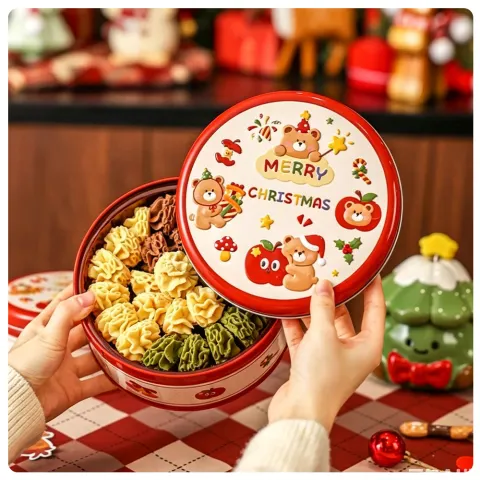
Product-specific buying guides for the categories we produce most: tea tins, candle tins, cookie and biscuit tins, candy and chocolate tins, gift and promotional tins, and reusable storage and cosmetic tins. Each guide covers the sizes, closures, coatings and print options that category actually needs.
Prefer one flat list sorted by date, with no grouping at all? The complete archive lists every article newest-first, with reading times and no filtering.
Send us your capacity, shape and target market. We reply within a day with structure and decoration options, including matches among ready-made moulds.
What is the minimum order quantity for custom tin cans?
Stock sizes start from 1 piece with no tooling fee. Custom-tooling designs typically start from 1,000 pieces. The exact band depends on diameter and structural complexity, and we quote it per design.
How much does a custom tin can cost?
Unit price is driven by material gauge, body size, structural complexity, printing process and finishing. A 1-piece stock size and a 1,000-piece custom design are not directly comparable — the fair comparison is amortised tooling cost at the same spec. When requesting a quote, confirm whether tooling and sampling fees are included.
Can I order a sample before full production?
Yes. The usual route is a white sample or printed sample in 7–15 days, with the sample fee refundable against a production order depending on volume and terms. Sampling lead time depends on whether new tooling is required.
Are your tin cans food safe and compliant?
Tinplate substrate and food-grade coatings are both available, and suppliers can provide FDA 21 CFR / EU LFGB documentation for the material and coating. Ask for compliance declarations tied to your actual production batch rather than a generic catalogue.
What is the difference between tinplate and aluminium packaging?
Three variables decide it: barrier performance (tea, coffee, fragrance retention), cost at the same structure, and brand presentation (the weight and reuse rate of metal). See the tinplate vs aluminium vs plastic guide for a four-question framework.
How long does a custom tin can order take to produce?
Stock sizes run 7–15 days. Custom-tooling designs add a 20–25 day tooling cycle, then 15–20 days after artwork approval. Peak season and shipping method affect the total — quotes include a broken-down schedule.
Can I print my own logo and artwork on the tins?
Yes. Four-colour offset, single spot colour, or spot colour over CMYK are all supported. Coatings include white base, matte, gloss and overvarnish; structural finishing covers embossing, windows and retro illustration. Artwork is confirmed on a sample first.
Do you supply tins for small brands and startups?
Yes — stock sizes from 1 piece exist precisely for small batches. Custom tooling has a higher MOQ, but you can validate the market on a stock size first and decide on tooling later.
Keep reading
The case library holds 2,837 real production runs and the mould library holds 4,000+ stock sizes — the guides explain how to choose, the cases and moulds show how others landed it.