A small tin can looks like the simplest product in metal packaging — and that is exactly why so many first orders go wrong. In our case review sessions, the same three mistakes keep coming back: a buyer orders a "50 g tin" without checking whether that means the can's own weight or its fill capacity; a lid style gets picked from a photo instead of from how the product will be used; and decoration is designed as if the lid were a poster, when it is a 50 mm circle seen from half a metre away.
None of these mistakes is expensive to avoid — if you catch them before tooling and printing. This guide is built around the questions buyers actually ask when a small or mini tin can is their first custom metal package: which sizes exist as standard tooling, how to translate grams into a can that fits, which tin can with lid style matches your product, what coating your balm or tea needs, what decoration survives on a small surface, and how to buy tiny tins wholesale without getting stuck with a container you cannot sell. Every section ends with something you can act on: a table, a checklist, or a real production case from our case gallery.

The 30-second chooser
If you only skim one section, make it this one. Find your situation in the left column; the right columns tell you where to focus.
| Your situation | Start here | Biggest risk |
|---|---|---|
| First time ordering metal packaging | Standard sizes from a ready mould library | Designing a custom size before validating demand |
| Selling a balm, salve or solid perfume | Tight slip lid + food-safe coating | Lid too loose; coating not cosmetic-grade |
| Packaging loose tea or coffee | Airtight slip lid, taller body | Flat can with too much headspace; aroma loss |
| Travel candle or wax melts | 65–85 mm round, deeper body | Wax shrinkage; lid rattling in transit |
| Trade-show samples or subscription boxes | 30–45 mm blank or single-colour tin | Over-decorating a giveaway |
| Gift or collectible product | Hinged or book-style tin, full lithography | Under-investing in decoration |
Everything below expands one of these rows.
Small tin can sizes: diameter first, grams second
The fastest way to waste a sample cycle is to specify a small tin by weight alone. Metal tins are described by diameter × height, and the same nominal weight can sit in very different bodies. A 50 g capacity in a wide, shallow tin looks generous on a shelf; the same 50 g in a tall, narrow tin looks clinical. Both are correct engineering answers to different briefs.
The gram-vs-volume trap
Capacity in grams only becomes meaningful once you know your product's bulk density. One gram of loose leaf tea occupies roughly three to four times the volume of one gram of balm. So before you pick a size, answer one question: how many millilitres does your fill actually take? The table below gives working estimates we use for first-pass can selection — treat them as engineering approximations, not lab values, and always confirm with a physical fill test.
| Fill product | Approx. bulk density | 50 g of product needs roughly |
|---|---|---|
| Balm, salve, solid perfume | ~0.9–1.0 g/mL | 50–55 mL — a shallow 65 mm tin |
| Wax, candle blend | ~0.8–0.9 g/mL | 55–65 mL — a deeper 65–70 mm tin |
| Loose leaf tea | ~0.15–0.3 g/mL | 170–330 mL — a tall 65 mm caddy or wider body |
| Ground coffee | ~0.3–0.4 g/mL | 125–165 mL — a tall narrow tin |
| Bath salts, granules | ~0.9–1.1 g/mL | 45–55 mL — a shallow wide tin |
| Small hardware, buttons | highly variable | count them into a known volume instead of weighing |
A practical rule: write your spec as "Ø mm × height mm, fill-tested with X g of product" — never as "a 50 g tin". Suppliers quote faster and misquote less when diameter and height are explicit.
Which sizes exist as standard tooling
Small tins are produced from standard moulds that factories keep permanently, which is why a ready mould library can offer thousands of bodies without tooling cost. Most standard bodies fall into five diameter bands:
SVG diagram of the small tin size ladder from 30 mm to 100 mm with capacity bands and typical productsThe size ladder: five diameter bands that cover most small tin can applications, from 5 g sample tins to 200 g gift sets.
Three notes on using the ladder:
- Below 30 mm you are in promotional-coin territory: charming, but filling and capping get fiddly, and per-unit printing space is nearly zero.
- 30–65 mm is the workhorse band for cosmetics, samples and single-serve tea — the widest choice of standard moulds and the friendliest unit prices.
- Above 85 mm you are approaching "small-to-medium tin" territory: the same rules apply, but shipping carton counts drop and dent protection starts to matter (more on that in the wholesale section).
Round bodies dominate the standard catalogue, but square, rectangular and oval formats exist as standard tooling too — and for shaped products, the special-shaped tin cases (over 200 documented production runs) show how far standard-style tooling stretches before you need fully custom moulds.

Tin can with lid: pick the closure by scenario
"Tin can with lid" hides more engineering than any other part of a small tin. The lid decides freshness, one-hand usability, perceived quality and a chunk of the unit price — so pick it from a scenario, not from a catalogue photo.
SVG decision guide matching four product scenarios to slip lids, flip lids, book-style tins and standard slip lidsFour scenarios, four closures: match how the product is used to the lid mechanics before anything else.
The four scenarios that settle it
- Freshness first (tea, coffee, balms): a tight slip lid with a rolled rim is the default. The Black Cat Tea Story airtight tin is a good reference: a straight-walled body with a deep slip lid that seals on the inner wall, not on a printed top surface.

- Reopened constantly (candy, stationery, desk items): a hinged flip lid. Losing a small lid is the fastest way to make a small tin feel cheap. The Candy flip-lid case shows the mechanism done simply.

- Opening as brand theatre (gifts, collectibles): book-style or double-lid constructions slow the unboxing down on purpose.
- Speed and budget (samples, giveaways): the plain standard slip lid, minimal or no print, ships fastest.
If you want the full mechanical taxonomy — slip, hinged, nesting, window, book-style — we keep a dedicated guide to tin can lid types.
Small-lid troubleshooting: symptoms, causes, what to specify
Most small-tin complaints trace back to one line missing from the spec sheet. Before you approve a sample run, check this table:
| Symptom in samples | Usual cause | What to put in the spec |
|---|---|---|
| Lid slides off too easily | Slip tolerance too loose for this diameter | Specify "slip lid, tight friction fit, pull-off force tested" |
| Lid impossible to open one-handed | Tolerance too tight; no knurl or tab | Add a knurled edge or tab; relax tolerance |
| Lid scratches the printed side wall | Lid rim rubs body in transit | Ask for clear lacquer on sidewall, or individual poly bag |
| Balm leaks at the rim in heat | No inner seal under a slip lid | Add inner liner or heat-sealed foil membrane |
| Lid rattles inside shipping carton | Empty headspace; no top pad | Spec a top card pad, or reduce headspace via fill test |
| Printed logo scratches off | Print on the friction surface | Move print off the seal line; add varnish |

Food-safe coatings: what actually touches your product
A small tin's body is tinplate — steel with a thin tin layer — and the inside of that body is what your balm, tea or candy actually touches. Uncoated tinplate is fine for dry, non-acidic products and is even part of the look in "raw metal" designs. But for anything oily, wet, acidic, or intended for skin contact, you need an internal lacquer, and the words matter: food-grade coatings for edible fills, and cosmetic-compatible lacquers for balms and salves.
Two practical points that first-time buyers miss:
- The coating is chosen per product family, not per can. A lacquer that is perfect for dry tea can fail with a citrus-infused balm. Tell your supplier what the fill is made of, not just what category it is.
- Certification questions belong in the first email, not the last one. If your market expects FDA or LFGB compliance, say so up front — our guide to food-safe tin cans and coatings explains the differences.

Decoration on a small lid: what actually works
A 50 mm lid is roughly a large coin's worth of visual real estate, viewed from a metre away. Decoration decisions that work on a biscuit tin quietly fail at this scale — so it helps to split the options into what earns its place and what does not.
What works on small tins:
- One bold element. A single logotype, a single icon, or a single colour block reads at arm's length. The Color Blockstationery case builds an entire identity from two colour fields.
- Hot-foil stamping for a premium cue at low coverage — foil on a small lid reads as "expensive" precisely because it is restrained.
- Embossing or debossing of one shape. Relief catches light and gives fingertips something to find. On mini tins it often outperforms a fourth print colour.
- Two-tone constructions — one colour outside, contrasting inside. Opening a silver-lined gift tin reveals a second design decision for almost no extra cost.

What to avoid: type below roughly 6 pt (it fills in on metal), full gradients compressed into a 30 mm circle, and "small print legal text" — put that on a base label instead. If you are weighing print systems for a bigger package line, the tin can printing options guide compares lithography, digital and foil in detail.
Where small tin cans sell: five categories, real cases
Small formats earn their place in five product families. For each, the case gallery shows how working brands solved the same problem you are looking at — sizes are one of the few things you should never decide in a vacuum.
Sample and trial tins
The classic 5–15 g tin for trade shows, subscription boxes and discovery sets. Unit cost and speed matter more than decoration, which is why blank or single-colour bodies dominate. One underrated tactic: keep one can body and print only the lids per SKU. The round caddy series runs 26 SKUs on shared bodies — the economics of small-batch variety change completely when the body is common and only the top changes.
Cosmetics and skincare
Balms, salves, solid perfumes and small storage sets. Priorities: airtight slip lid, cosmetic-grade interior, and an unboxing that survives being opened fifty times. The Herbal Skincaresmall storage tin adds a fitted interior tray, which turns a simple small tin into a set — and raises the price ceiling accordingly.

Beauty brands weigh different trade-offs than food brands; the cosmetic tins guide covers sizing for balms versus jars.
Tea and coffee portions
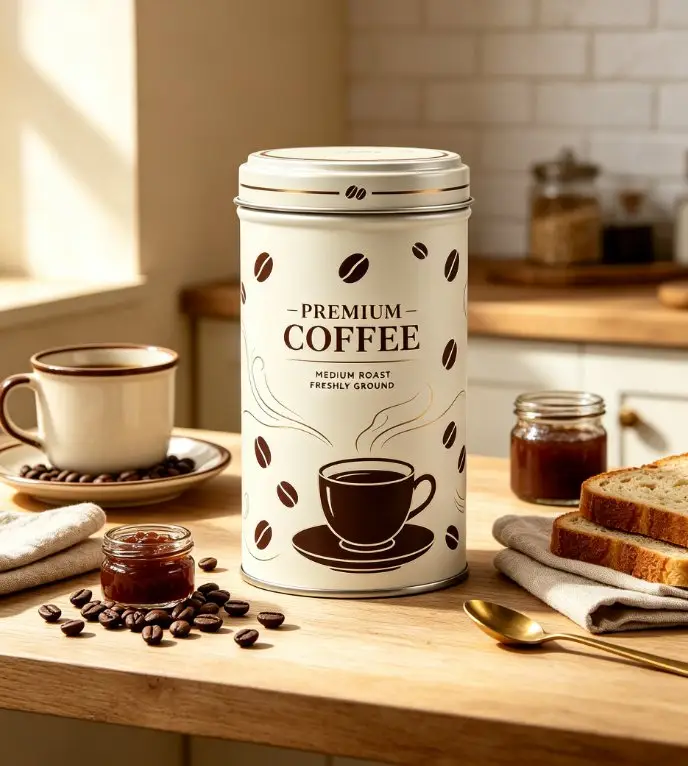
Single-serve and travel formats live or die on resealability and aroma barrier — which makes this the category where lid choice matters most. Tall narrow bodies keep headspace low for ground coffee, like the Origin Coffee Tinsingle-origin tin. For leaf tea, our tea tin packaging guide explains why caddies outperform pouches on shelf life.

Candles and wax melts
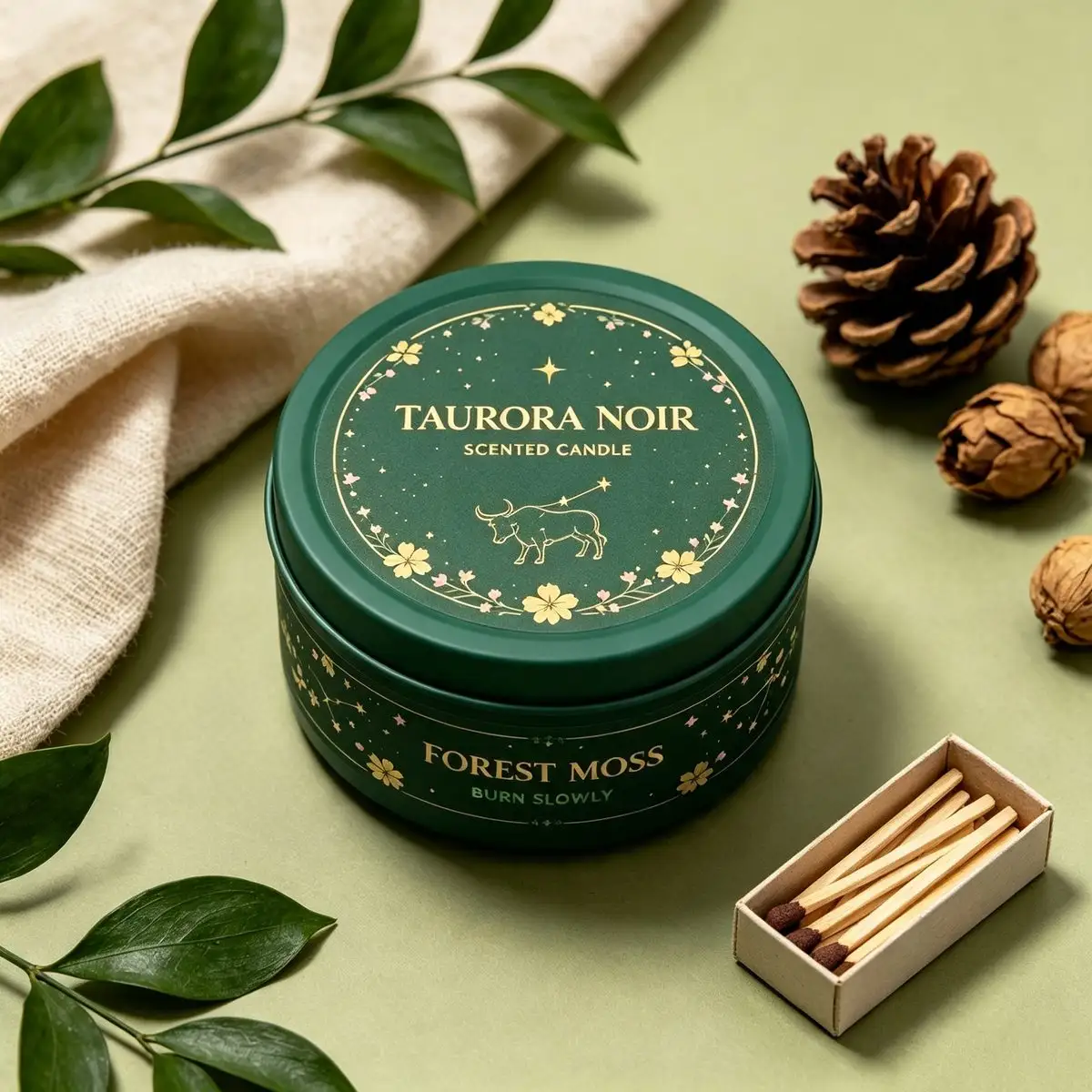
Small tins are the standard travel-candle format. The engineering questions are specific: wax shrinkage against the wall, wick centring, and a lid that fits loosely enough to clear the wax surface but not rattle in a courier van. The candle tins guide covers pour and sizing details; the Blue Elegance Candle Tincase shows a finished travel candle at typical mini dimensions.

Gifts, stationery and small storage
This is where decoration carries the purchase: pen tins, jewellery boxes, collectible sets. The Golden Branch Square jewellery tin uses a small square body with embossing for rings and earrings; the Cute Bear gift case shows illustration-led design for candy and small gifts. The stationery tin cases category collects 36 documented runs if you are building a desk-product line.


Across all five categories, the full case gallery — 2,838 documented production runs at the time of writing — is the fastest way to see which diameter, lid and decoration combinations already exist, before you invent one.
Buying tiny tins wholesale: MOQ, spot orders and shipping
Why small formats have the lowest entry barrier
Because small tins run on standard, permanently held moulds, the biggest cost in custom metal packaging — tooling — simply disappears from your quote. That changes the buying game in three ways:
- Minimums drop. With no mould to amortise, production can start at small practical volumes. The low-MOQ custom tins guide explains how far standard-tooling MOQs go.
- You can afford breadth. Sampling three sizes and two lid styles costs little extra, and sell-through data — not opinion — picks the winner.
- Spot orders cover your gaps. When a promotion outruns a production run, spot orders from ready stock ship in days while your custom line is still on the line. For seasonal products, that option alone protects revenue.
If this is your first bulk order from a metal packaging factory, the wholesale sourcing guide walks the full process from RFQ to container.
Getting small tins there without dents
Small tins are light, which tempts buyers into minimal packaging — and light tins dent. Three cheap safeguards:
- Individual bags or sleeves for printed bodies, so lids cannot rub walls in transit.
- Top pads on tins with empty headspace; a rattling lid is self-inflicted damage.
- Fill a test carton before the production order. Ten tins in a box tell you more about dents than any spec sheet.
Pre-order checklist for a small tin can
Before you approve a sample run, make sure every line below has an answer in writing:
- Dimensions: diameter × height in mm, plus a fill test with your actual product — not a nominal gram figure.
- Lid style and fit: slip / hinged / book-style, with pull-off force described in words, and an inner liner if the fill can leak.
- Interior coating: named for your product family (food-grade, cosmetic-grade), with the compliance your market expects.
- Decoration: print system, number of colours, emboss depth, and a rule that nothing critical sits on the sealing surface.
- Transit protection: individual bags, top pads, and a filled test carton.
- Commercial terms: MOQ for the standard body, spot-order availability for emergency top-ups, and the quote broken into body, lid, print and packing.
If you would rather start from a proven body: browse the 4,000+ ready moulds, generate a first visual with the AI packaging mockup tool, or request a quote with your fill weight and market — a specific question gets a specific answer.
FAQ
What sizes do small tin cans come in?
Most standard tooling falls between 30 mm and 100 mm in diameter, covering roughly 5 g to 200 g of usable capacity depending on the fill's density. Below 30 mm is promotional-coin territory; above 100 mm the same rules apply but carton counts and dent protection change. Browse the mould library to see real diameter-and-height combinations.
How do I convert grams into a tin size?
Convert your fill to millilitres first using its bulk density — one gram of loose leaf tea takes three to four times the volume of one gram of balm — then choose a diameter-and-height body that holds that volume with modest headspace. Always confirm with a physical fill test before tooling.
Which lid should I choose for a mini tin can?
Match the lid to the scenario: tight rolled-rim slip lids for freshness (tea, coffee, balms), hinged flip lids for frequent one-handed use (candy, stationery), book-style or hinged constructions for gifts and collectibles, and standard slip lids when budget and lead time dominate. The decision guide above maps all four.
Are small tins food-safe for cosmetics and tea?
Yes, when the interior carries the right lacquer: food-grade coatings for edible fills and cosmetic-compatible lacquers for skin-contact products. Uncoated tinplate suits dry, non-acidic fills. State your product family and target-market compliance (FDA, LFGB) in the first enquiry.
What is the minimum order for tiny tins wholesale?
Because small tins use standard, permanently held moulds, there is no tooling cost to amortise, so wholesale programs start at small practical volumes and scale up to container loads. Spot orders from ready stock can cover urgent gaps within days.
Can I get my logo printed on a very small tin?
Yes, but design for the scale: one bold element, foil or embossing for premium cues, and no type below roughly 6 pt. Full gradients and small legal text do not survive on a 30–50 mm lid — move them to a base label.
How do I keep small tins from denting in shipping?
Use individual bags or sleeves for printed bodies, add top pads to tins with headspace, and run a filled test carton before the production order. Light tins dent when they can move — immobilising them cheaply is the whole task.
Can one small tin body serve multiple SKUs?
Yes — that is one of the strongest economic arguments for small tins. Keep the body standard and vary only the printed lid, as in the 26-SKU round caddy series above; per-SKU cost drops to lid printing alone.
Conclusion: pick the scenario, then the tin
A small tin can is the lowest-risk entry into metal packaging — but only if the size comes from a fill test, the lid from a use scenario, and the decoration from the realities of a 50 mm circle. Start from a standard body in the mould library, validate with samples, and let the case gallery show you proven combinations before you commit. From a 5 g sample tin to a 200 g gift set, the platform runs from idea to instant quote in days.
About CNTINWORLD: an intelligent packaging design platform connecting moulds, cases, AI creativity, customization and quotation in one workflow — tin packaging since 1997.