A custom tin box quote is the cheapest research you will ever buy — and the most expensive thing to get wrong. The quote itself costs nothing. What it protects you from is the real exposure: a mould you cannot reuse, print plates for an artwork that changes twice, a container of tins with lids that do not close properly, and a launch date that slips while you wait for email replies.
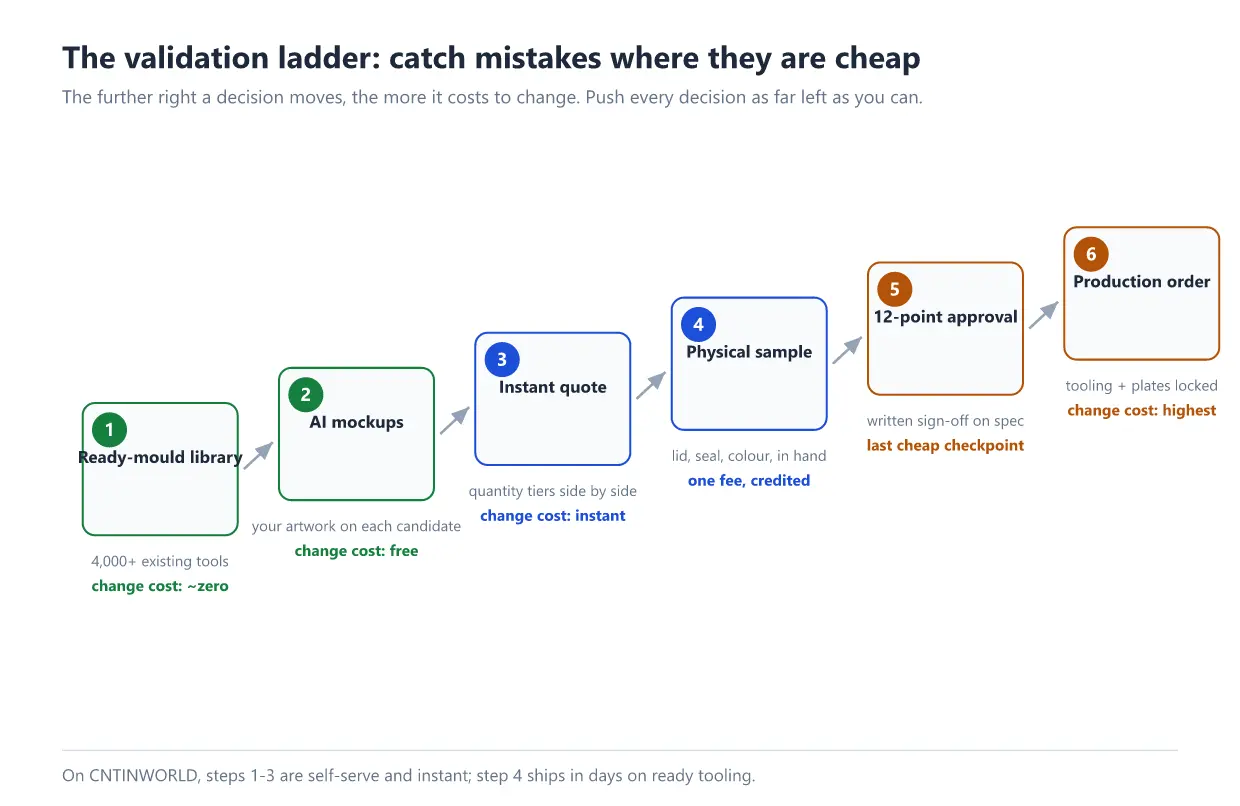
Most buyers do not lose money because their supplier is expensive. They lose it because three decisions — structure, decoration, and quantity — get locked in before anyone has tested them. This guide shows you how to validate each one at sample cost instead of production cost, using instant quotes, a ready-mould library, and a disciplined approval checklist.
Here is the short version, then the detail:
| Decision you make early | What it locks in | Cheapest way to validate it |
|---|---|---|
| Structure (shape, lid, insert) | Tooling or mould selection | Pick from a ready mould library, adjust on the sample |
| Decoration (print, emboss, finish) | Plate charges and colour matching | AI mockup before any plate is made |
| Quantity and batch size | Unit price and cash flow | Compare quantity tiers in a single quote |
| Product contact / barrier | Internal coating spec | Match the coating to the product, confirm on the physical sample |
What you are really risking before the first production run
Before a single tin ships, a typical project has already committed to four kinds of cost that are hard to reverse:
- Tooling. A new mould is the single largest line item in most first orders. If the shape is wrong for your product or your shelf, that money is gone.
- Print plates. Every colour and every special effect (hot stamping, embossing, spot varnish) adds plates. Artwork revisions restart this clock.
- Minimum order quantity. You pay for the MOQ whether you sell through it or not.
- Time. A two-week quote cycle repeated across three suppliers is a month of your launch window.
This is why a fast metal packaging quote matters more than it looks. It is not about impatience — it is about how many designs you can afford to test before you have to commit.
What an instant quote actually tells you (and what it does not)
On CNTINWORLD's instant-quote workflow, a quote starts from the mould library — 4,000+ ready tin box moulds — so the price you see is attached to tooling that already exists. That single fact changes the nature of the number you are looking at: it is a manufacturable price, not a sales estimate waiting to be revised.
You choose a base model, add decoration and finish options, and the quote returns with multiple quantity tiers side by side — so you can see where the unit price bends instead of asking a salesperson to guess your batch size.
What an instant quote does not tell you — and where you still need to ask questions:
- Freight reality. Unit price excludes what happens when 20,000 tins meet a pallet. Stackability and carton configuration change landed cost.
- Seasonal plate queues. Before peak season (Q3 for Christmas packaging), decoration capacity, not tooling, is the bottleneck.
- Coating lead time. Food-contact lacquers matched to acidic or oily products can add days to the first sample.
For the full cost anatomy, read what actually drives the cost of a custom tin can — it pairs well with this guide.
The five numbers that move your unit price
When you compare quotes — from us or from any tin can supplier — these are the levers worth interrogating:
| Cost driver | What moves it | Where buyers get trapped |
|---|---|---|
| Tinplate gauge | Thicker steel = more rigidity, more cost | Too light a gauge saves cents and costs dents in stacking — see the tinplate gauge guide |
| Quantity tier | Volume breakpoints are not linear | Quoting 5,000 when 4,800 would have hit a better tier |
| Decoration count | Each colour / plate / special effect adds cost | Discovering at sample stage that the design needs a fifth colour |
| Lid and closure type | Slip, clamp, screw, window, hinged all price differently | Choosing a lid for looks, then adding a seal afterwards — see lid types explained |
| Insert or lining | EVA, PET tray, paper, or none |

The 30-second shortlist: how to cut 40 candidate designs down to 3
The case library — 2,837 real packaging cases at the time of writing — is the fastest way to see what has actually been produced, not what renders well. But browsing it casually takes hours. Here is the filter we recommend:
- Filter by shape and capacity first, artwork second. Artwork is the cheapest thing to change; tooling is the most expensive. If the structure is wrong, nothing else matters.
- Prefer designs built on existing moulds. A special shape is only a risk if the tooling does not exist yet. Plenty of special-shaped runs — pop-top tins, heart-shaped tins — are built on ready tooling.
- Match decoration ambition to your quantity. Embossing, metallic exposure, and multi-colour printing all look premium on 10,000-piece runs and painful on 1,000. If your quantity is low, pick a case that achieves its look with one or two spot colours.
- Keep only designs you could sample this week. If a candidate needs a new mould and a new artwork, it is a different project, not a validation step.

Run your three survivors through the AI packaging design tool and you get mockups of each candidate on your own artwork in minutes — which is usually the moment the whole team agrees on a direction, and the moment you stop paying for opinions.
Sampling: where the money actually goes, and how to spend a fraction of it
Traditional sampling is expensive for a structural reason, not a greed reason: the supplier has to make or modify tooling, produce plates, and run a small batch on a production line scheduled for big ones. Several of those costs get charged whether or not you proceed.
Sampling from a ready mould removes most of that chain. This is what the comparison looks like:
| Cost item | Traditional route | Ready-mould route on CNTINWORLD |
|---|---|---|
| Artwork mockups | Paid design rounds; revisions re-quoted | Free AI mockups; iterate before anything is printed |
| Tooling for the first sample | Full mould charge, even for a "maybe" | Sampling against existing tooling — the platform's standard terms include free sampling on ready-mould designs |
| Sample fee | Usually a sunk cost | Credited against your production order |
| First sample lead time | Weeks, queued behind production | Days, run on dedicated sample capacity |
| Quote turnaround | Days per revision | Instant, self-serve |
The practical consequence is not just "cheaper samples". It is that you can afford to test competing structures. For a brand launching two SKUs, sampling two or three candidate shapes and choosing from physical samples is now a normal move instead of a luxury.
Six real production runs you can benchmark
Every case below is a real production run from the case library, with its published MOQ and spec. They are not chosen because they are pretty — they are chosen because each one settles a different argument that comes up in every packaging project.
1. Structure first: the round airtight tea tin (73×120 mm)

120 airtight canister · full case here*
This run proves the boring, decisive point: the body, the seal and the lid were validated as a structure before anyone debated the artwork. For tea, coffee and anything moisture-sensitive, start in the airtight mould category (40 ready-made airtight moulds) — sealing performance is a mould property, not a printing one.
2. Locking a decoration spec in writing: the fresh-lock coffee tin

Notice the spec: printing method, embossing, finish, capacity, MOQ — all stated. That is exactly what your sample approval should look like on paper. If your quote cannot list these five things, it is not a quote yet.
3. Premium look on a modest budget: the square candy tin

Character art reads as premium because the colour plan is disciplined: flat colour areas, one dominant brand colour, white space doing the work. This is the cheapest premium effect in metal packaging — no special finish required. Compare it with the gilded and metallised options in the gift tin cases before you commit to foil.
4. Special shapes without tooling risk: the heart-shaped gift tin

Special shapes sell the gift category — and they are exactly where sampling earns its fee. A heart shape wraps artwork around curves that mockups handle badly on paper and physical samples handle honestly. If your design is special-shaped, budget your first sample round as non-negotiable.
5. Structure as differentiation: the pop-top biscuit tin

A pop-top opening is a structural choice with real consequences: it changes the lid cost, the opening experience, and the snack's resealability story. Test the mechanism in hand before you print 20,000 of them.
6. Embossing as low-cost depth: the embossed cookie tin

Embossing adds perceived depth without adding ink. It does need plate tooling and a gauge that holds the relief — which is why it belongs in the sample decision, not the artwork debate. See how it fits among metal can printing processes.
Two more categories worth a look before you shortlist: small candle tins, where decoration carries most of the perceived value, and colourful cosmetic tin runs at MOQ 1,000, useful if you are testing a beauty SKU.
The 12-point sample approval checklist
Most production surprises are visible in the sample — they are just not looked for. Print this list and physically work through it with the sample in hand.

Structure
- [ ] Lid opens and closes with the right resistance — 20 open/close cycles, no loosening
- [ ] No sharp edges at rim or seam (run a finger around every edge)
- [ ] Stable upside-down and under a light stack load
- [ ] Insert or tray fits the actual product, not a stand-in
Decoration
- [ ] Print colour matches your brand assets under daylight, not just office light
- [ ] Embossing depth is even across the whole panel
- [ ] No scratches, dots or streaks in the print (inspect under raking light)
- [ ] Finish (matte / gloss / metallic) matches what the quote promised
Function and compliance
- [ ] Seal or closure keeps the product fresh for a realistic interval — test with the real contents
- [ ] Internal coating is the one specified for your product (acidic, oily, alcohol) — see food-grade coatings explained
- [ ] Odour check after 48 hours sealed
- [ ] Carton and pallet configuration confirmed with the weights and quantities you will actually ship
When a sample fails: symptom, likely cause, and what to ask for
A failed sample is not a failed supplier — it is unfinished engineering. What matters is how precisely you can describe the problem.
| Symptom | Likely cause | What to ask for |
|---|---|---|
| Lid too loose or too stiff | Tolerance stack-up between body and lid | Which dimension drifted, and the corrected tolerance on the next sample |
| Print colour off | Proof approved on paper, production on metal | A print drawdown on the actual tinplate before mass plates are made |
| Print scratches easily | Varnish spec too light for the distribution channel | Abrasion test standard and a harder varnish option |
| Dents in stacking | Gauge too light for the stack height | A gauge recommendation for your pallet config (see the gauge guide) |
| Rust spots after weeks | Tin layer or lacquer coverage gap | Coating weight spec and corrosion test method |
| Embossing looks shallow |
Bring this table to the review. "The lid is too tight" starts a conversation; "the lid opening torque drifted, please confirm the corrected dimension in writing" starts a fix.
Lock these five things in writing before you release the PO
- The spec sheet as sampled — gauge, dimensions, lid type, coating, printing method, finish, insert. If it changed during sampling, the sheet changes with it.
- The artwork file list — dieline version, colour references, minimum font sizes, bleed. This is where re-plates hide.
- The sample-fee credit — the exact amount and the invoice line it appears on.
- Inspection standard — AQL level, critical/major/minor definitions, and who pays when a batch misses it.
- The timeline — plate-making, printing, forming, packing, and the port or warehouse cut-off, in dates not weeks.
From spec sheet to bulk delivery walks through what happens on the factory side of those five lines — useful reading before you sign.
If you cannot wait for sampling at all
Sometimes the deadline wins. When packaging is needed in weeks rather than months, ready-stock spot orders ship standard tins with your printing on existing tooling — no validation loop, shorter lead time, less design freedom. A simple rule of thumb:
| Situation | Better route |
|---|---|
| Launch date fixed, design flexible | Spot order now, custom programme later |
| Design fixed, quantity unproven | Sample first, scale after |
| New SKU, unknown demand | Low-MOQ custom run — see MOQ and sampling for small brands |
| Replenishment of a proven design | Custom production, planned ahead of peak season |
Worked example: validating a two-SKU tea launch (illustrative numbers)
Here is the arithmetic that makes the workflow concrete. Numbers below are illustrative — use your own quotes — but the structure of the decision is real.
You are launching two teas. You have shortlisted four structures from the mould library.
| Step | Option A: sample one, commit | Option B: mockup four, sample two, commit one |
|---|---|---|
| AI mockups of four candidates | not done | free, same afternoon |
| Instant quotes for all four | one | all four, one screen |
| Samples ordered | one | two |
| Risk carried into production | artwork + structure untested against alternative | structure tested; artwork tested on the winning shape |
| If a structure fails in market testing | tooling already committed | nothing committed — the losing sample cost one sample fee, credited to production |
Option B is not more expensive in any meaningful sense — it costs one extra sample fee. It is dramatically cheaper in the only currency that matters: the cost of being wrong about a structure after tooling.
FAQ
How fast can I get a custom tin box quote?
On ready moulds, instantly: pick a model, choose decoration and finish options, and the quote — with multiple quantity tiers — returns on screen. Custom shapes that need new tooling still need a human estimate, but you will know that from the first click, not from a week of email.
How much does a custom tin box sample cost?
It depends on tooling. Sampling against an existing mould is inexpensive — and on CNTINWORLD the standard terms include free sampling on ready-mould designs, with sample fees credited against the production order. A sample that requires a new mould carries tooling cost, which is exactly why validating on an existing mould first is the cheap path.
What is the minimum order quantity for custom tin cans?
It varies by mould and decoration, but real production runs in the case library publish MOQs from 1,000 to 3,000 pcs. If you need lower, the practical routes are smaller moulds, simpler decoration, or a spot order — this small-brand guide covers the trade-offs.
How long does tin packaging sampling take?
On ready tooling, the first physical sample is measured in days. Add time for artwork mockups and one revision round, and "shortlist to approved sample" typically fits inside a week or two. New tooling adds mould-making time to the front of that.
What is the difference between a spot order and custom sampling?
A spot order ships existing stock, optionally with your printing, on short lead times — right when the deadline is fixed. Sampling is how you validate a design you intend to produce at scale. They solve different problems and many buyers use both: spot stock now, custom programme next season.
How do I compare quotes from different tin can suppliers?
Compare the same five numbers: gauge, quantity tier, decoration count, lid type, insert. Then compare what each quote assumes about freight and inspection. A quote that cannot state its assumptions is a proposal to negotiate, not a price.
Can I get a quote before my artwork is finished?
Yes, and you should. Structure and decoration method drive most of the price; the artwork affects plates and colour count, not the body. Generate a mockup with the AI design tool, quote on the structure, and finish the artwork while the sample is in transit.
What should I send with my enquiry to speed things up?
Target quantity, target unit price if you have one, product type (food, cosmetic, gift…), any barrier or food-contact requirement, and the closest case from the library as a reference: "something like this, 250 g capacity, MOQ around 3,000". That single message replaces the first three emails of a normal enquiry.
Conclusion: quote fast, sample cheap, approve with a checklist
A fast quote does not make your packaging project better on its own. What it does is change what you can afford to test: four structures instead of one, two samples instead of a coin flip, a physical lid test instead of a hopeful rendering. Combine the instant quote workflow with a ready-mould library and a written approval checklist, and the expensive mistakes move from your production order — where they are permanent — to your sampling budget, where they are tuition.
Ready to test your packaging idea without the usual cost and delay? Browse 4,000+ ready tin box moulds, generate a mockup with AI packaging design, or get an instant custom tin box quote — and go from idea to approved sample in days, not months.
About CNTINWORLD: TIN is an intelligent packaging design platform connecting moulds, cases, AI creativity, customization, and quotation in one streamlined workflow — tin packaging since 1997. From tea tins to candle tins, turn your idea into production-ready packaging in days.