Plastic is losing favor with regulators and shoppers at the same time, and brands are scrambling for packaging that survives scrutiny. Sustainable metal packaging has become the default answer: infinitely recyclable, highly protective, and endlessly reusable. But an eco-friendly claim only converts buyers when real evidence sits behind it — and in 2026, "evidence" increasingly means regulatory paperwork, not marketing copy.
This guide gives importers, brand owners, and wholesalers the full picture: why metal tins keep winning the circular-economy argument, what the EU's PPWR and the growing patchwork of US EPR fees actually require from you, which certificates to request from your supplier, and how to design a recyclable metal tin that tells a story customers believe.

Your Options at a Glance
Before going deeper, here is how the four materials buyers usually compare actually stack up when the goal is a defensible eco claim.

Why Metal Wins the Circular Economy
Metal is the poster child of circular packaging because it can be recycled endlessly without losing quality. Steel and aluminum packaging recycling rates in Europe regularly exceed 75%, and tinplate food cans rank among the most recycled containers in the world. A recyclable metal tin that returns to the supply chain keeps its material value across life cycles — it becomes new packaging, not landfill cover.

Figure 2. Tinplate starts as recycled steel: sheets are cut, formed, and printed into new metal packaging with no loss of material quality.
The reuse advantage most buyers undervalue
Recycling is the second-best outcome. Reuse is the best. A metal tin has a second life as storage — a cookie tin that holds sewing supplies for five years carries a far smaller footprint than any single-use package, and it keeps your brand visible in the customer's home the entire time. That reuse value is simultaneously a sustainability credential and a marketing asset: it is the reason consumers keep the tin rather than discard it.

Figure 3. The highest rung of the waste hierarchy: a reusable metal tin in active second-life use keeps material value and brand visibility for years.
For importers the takeaway is concrete: eco friendly tin packaging does not force a trade-off between environmental credibility and premium shelf appeal. The same properties that make metal protective — barrier, strength, hygiene — are the properties that make it circular.

Figure 4. The closed loop of metal packaging recycling: steel comes back as steel, indefinitely.
The 2026 Regulatory Reality: PPWR and US EPR
Regulation is now the strongest driver of packaging decisions, and 2026 is the year it stopped being theoretical.
What the EU PPWR changes from August 2026
The EU's Packaging and Packaging Waste Regulation (PPWR) entered into force in February 2025 and its first requirements began applying on 12 August 2026. Three points matter directly if you ship tins into Europe:
1.All packaging placed on the EU market must be recyclable. Plastic packaging faces mandatory recycled-content targets and design-for-recycling grading from 2030; metal packaging is not subject to recycled-content quotas and is already well positioned on recyclability grading.
2.Food-contact packaging is subject to strict PFAS limits, alongside heavy-metal restrictions. This pushes food brands toward proven food-contact coatings and away from ambiguous "greaseproof" paper solutions.
3.EPR registration is mandatory in every country where you sell, and non-EU companies must appoint an EU authorized representative. Metal's high recycling value keeps EPR fees for metal far below plastic — in some schemes the material generates a credit.
The earlier Single-Use Plastics Directive still targets specific plastic items; metal packaging is not among them.
Seven US states, seven rulebooks
There is no federal packaging EPR law in the United States. Seven states — Maine, Oregon, Colorado, California, Minnesota, Maryland, and Washington — have enacted their own programs, each with its own producer definition, reporting calendar, and fee schedule. California's SB 54 is the most demanding; Oregon and Colorado are already invoicing fees.
The fee mechanism is where material choice shows up on your P&L. Published fee schedules are eco-modulated: fees rise for materials that are hard to recycle and fall for materials that recover cleanly. In the schedules published so far, aluminum sits at the bottom of the fee range while multi-layer laminates and expanded polystyrene sit at the top — a spread of more than twenty times between the cheapest and most expensive material categories.
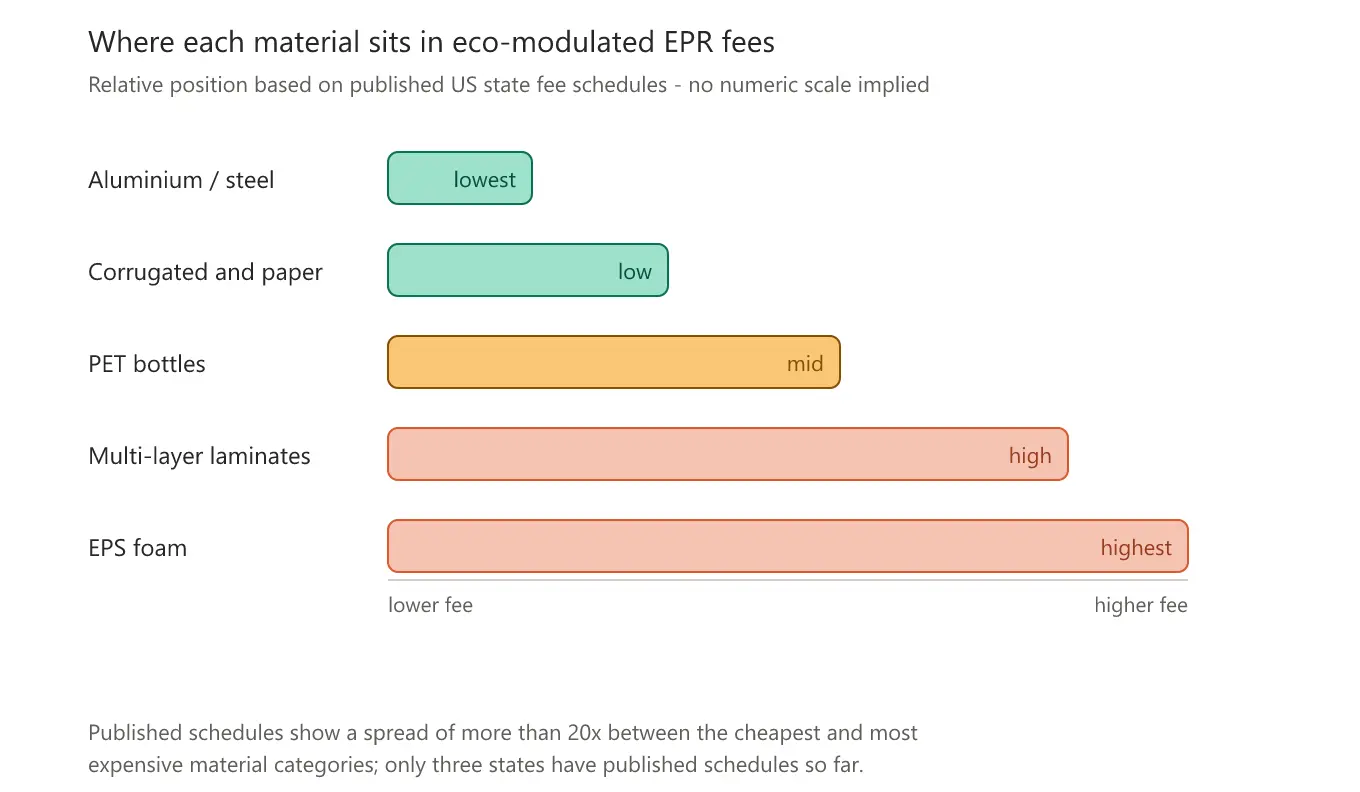
Figure 5. Relative EPR fee position by material, based on published US state schedules: metals and corrugated sit at the low end, multi-layer laminates and EPS at the high end. Only three states have published schedules so far; treat exact percentages as unverified.
The practical reading: switching a laminate pouch to a recyclable metal tin is not only a sustainability story, it is a recurring fee reduction on every unit you ship into regulated states. For a fuller material-by-material comparison, see tin vs plastic vs glass food storage.
Evidence That Survives an Audit
Not every eco-friendly claim survives an audit, so buy from factories that can document their materials. Request these five items before you place an order:
●Substrate certificate — states tin coating weight and steel source, so tinplate recyclability claims are traceable.
●Recycled-content statement — tinplate commonly contains recycled steel; get the figure in writing if you want to print it.
●Food-contact coating certificate — confirms the internal lacquer is compliant for your product. See are tin cans food safefor what the certificates should say.
●Heavy-metal and PFAS declaration — now a formal PPWR requirement for EU food-contact packaging.
●Disposal-mark artwork proof — the recycling symbols and material codes that will actually be printed on the tin.

Figure 6. A food-grade lacquer interior is what makes a recyclable metal tin suitable for direct food contact — and it is the certificate most often missing from supplier files.
On-pack claims are regulated in both the US and the EU. Recyclability claims must be accurate for your target markets, and recycling symbols should be printed on the tin or its label. Some brands add a QR code linking to local disposal instructions, which measurably reduces contamination in the recycling stream. For the decoration options available on tinplate, see tin can printing options explained.
Design Decisions That Make the Claim Real
The material is only half the story. Credible brands pair metal packaging with honest messaging and design choices that hold up when a customer, a retailer, or a regulator looks closely.
Print the claim, not the hype
"Infinitely recyclable" and "made from tinplate, a recycled steel product" are verifiable statements. Vague terms such as "eco" without evidence invite both regulator and consumer pushback. Younger demographics are the strictest judges of packaging claims, and European shoppers rank packaging recyclability among their top purchase criteria.

Figure 7. Finish choice changes more than shelf look: heavy varnish builds and foil laminates complicate recycling, while direct-print and matte or gloss lacquer on bare tinplate keep the package single-material.
Lightweight without weakening
Light-weighting is a direct lever on both cost and carbon: a slightly thinner tinplate sheet reduces material per unit without weakening the package. Ask your supplier which substrate grades and gauges are proven for your product weight and stacking load — the specification logic is the same as in tinplate gauge and thickness.
Spec the whole system, not just the can
Packaging is judged as a system. A recyclable metal tin with a molded kraft paper insert, a paper sleeve, and no plastic liner tells a far more complete story than a tin alone. Empty space counts too: PPWR void-space limits apply from 2030, so oversized tins with mostly air inside will age badly.

Figure 8. The complete bundle buyers now spec: metal tin, molded fiber insert, printed paper sleeve, no plastic anywhere in the set.

Figure 9. Every component in the set either supports the claim or undermines it — spec them together.
The 30-Second Decision Shortcut
If you only remember five things from this article:
1.Target market first. Selling into the EU means PPWR paperwork now; selling into the US means per-state EPR registration and fees.
2.Material second. Metal carries the lowest eco-modulated fee position of the premium options and is exempt from plastic recycled-content quotas.
3.Ask for five documents before quoting: substrate, recycled content, coating, heavy-metal/PFAS, disposal marks.
4.Design for single-material. Bare tinplate plus paper accessories beats tin plus laminate liners every time.
5.Print the verifiable claim, and put disposal instructions where the customer can find them.
How Brands Turn Compliance Into a Story
Regulation is a cost center; the story is a growth lever. The brands that convert best do three things consistently. They lead with the material fact — recycled steel, infinitely recyclable — rather than adjectives. They show the second life, because a tin that gets reused is the most tangible sustainability proof a consumer ever holds. And they make the recycling mark part of the design language instead of a legal footnote.
For wholesalers and private-label sellers, stocking eco friendly tin packaging is a practical way to differentiate from rivals still shipping in plastic. The packaging becomes a demonstrable reason to choose your listing over theirs, and the premium shelf feel pays back the higher unit cost. For cost planning, what actually drives the cost of a custom tin can breaks down where the money goes.
CNTINWORLD supports this end to end: food-grade internal lacquers, custom designs with recycling marks, and 8,000+ ready-made molds so you can scale sustainably without paying for custom tooling. See how food, tea, and cosmetics brands present their packaging in the case gallery, or browse tea tins for a ready category example. If you are comparing the two angles on this topic, our companion piece Is Metal Packaging Sustainable? covers refill systems and design trade-offs in more depth.
FAQ
Is tin packaging eco-friendly?
Yes. Tinplate is infinitely recyclable and is recovered at high rates in Europe and North America — European steel packaging recycling rates regularly exceed 75%. Combined with high reuse value, it is one of the most defensible packaging materials available.
What is the EU PPWR and does it affect metal tins?
The PPWR is the EU Packaging and Packaging Waste Regulation, which began applying on 12 August 2026. It requires all packaging placed on the EU market to be recyclable, sets PFAS and heavy-metal limits for food-contact packaging, and mandates EPR registration. Metal tins are well positioned: no recycled-content quota applies and recyclability grading is straightforward.
How do EPR packaging fees compare for metal vs plastic?
EPR fees are eco-modulated — they rise for hard-to-recycle materials and fall for clean-recovery ones. In published US state schedules, aluminum sits at the bottom of the range and multi-layer laminates and EPS at the top, a spread of more than twenty times. Metal's fees are far lower than plastic's, and some schemes credit the material.
Can my metal tin be made with recycled material?
Yes. Tinplate commonly contains recycled steel, and suppliers can document recycled content to support your on-pack claims. Request the recycled-content statement in writing as part of your sourcing file.
Do coatings on tins prevent recycling?
No. Standard lacquer layers burn off cleanly during steel recycling and do not contaminate the stream. What does complicate recycling is combining tin with non-metal parts — plastic liners, laminated films, or mixed-material closures — which is why single-material design matters.
Is a tin can more sustainable than a plastic container?
Across the factors that matter — recovery rate, material value at end of life, reuse potential, and EPR fee exposure — yes, with the caveat that any packaging is only as good as the system it is collected in. A recyclable metal tin in a market without collection infrastructure underperforms a well-recycled material in a mature system.
What documents should I ask a tin supplier for?
Five: a substrate certificate (tin coating weight and steel source), a recycled-content statement, a food-contact coating certificate, a heavy-metal and PFAS declaration, and disposal-mark artwork proofs. A factory that produces these without prompting is a factory you can put your claim behind.
Conclusion: Choose Packaging That Outlasts the Trend
Regulation and consumer preference have moved in the same direction: packaging that is infinitely recyclable is packaging that is future-proof. Sustainable metal packaging delivers protection, premium feel, and circular credentials in a single product — and in 2026 it also delivers something newer: a lower and more predictable compliance bill than any plastic alternative.
Start with the data your claim needs — material certificates, recycled content, and correct disposal marks — and let the tin itself do the marketing.
Ready to bring your packaging idea to life? Explore8,000+ ready-made molds, generate a custom design, or get an instant quoteat CNTINWORLD — go from idea to production in days, not months.
About CNTINWORLD: TIN is an intelligent packaging design platform connecting molds, cases, AI creativity, customization, and quotation in one streamlined workflow — tin packaging since 1997. From tea tins to candle tins, turn your idea into production-ready packaging in days.
Related Reading
●Is Metal Packaging Sustainable? Recycling, Refill and Design Choices
●Tin vs Plastic vs Glass Food Storage: Which Container Is Best?
●How to Source Custom Tin Boxes: A Buyer's Guide for Importers
●Tinplate Gauge and Thickness: How to Specify Metal for Your Tin Can